Tourist Places
The architectural heritage of a Renaissance town — from fortress walls to a wooden UNESCO church.

Zhovkva Castle
A Renaissance Fortress Where the Story of Zhovkva Began The castle stands right in the heart of the town, making it easy to combine your visit with a stroll through the old quarter of Zhovkva. Why It’s Worth a Visit This is not just "another castle"—it was once the residence of King John III Sobieski (Jan III Sobieski), and in the second half of the 17th century, the palace was among the wealthiest royal residences in Europe. Construction began in 1594 by order of Stanisław Żółkiewski, the town's founder and a prominent military commander of the Polish-Lithuanian Commonwealth. The project was supervised by the architect Paweł Szczęśliwy. Over several centuries, the fortress survived numerous sieges, but it suffered the greatest damage in the 20th century during the World Wars. Therefore, what you see today is mostly the result of meticulous restoration. What to See Today, the castle houses a museum where you can explore: restored palace halls, the authentic inner courtyard, thematic exhibitions dedicated to Zhovkva as a unique "Ideal City". You can book a guided tour, which is a great option if you want to dive deeper into the history and hear fascinating legends rather than just walking through the halls on your own. Workshops and quests are also available for children. Opening Hours and Ticket Prices The museum is open from Wednesday to Sunday, 10:00 AM to 5:30 PM. Monday and Tuesday are regular days off. Admission Tickets: Adults — 200 UAH Students — 150 UAH Children / Seniors — 100 UAH Workshops or Quests — 150 UAH Family Tickets: 1 Adult + 1–2 Children — 300 UAH 2 Adults + 1–2 Children — 500 UAH Guided Tours (for groups up to 20 people): Adults — 600 UAH Students — 500 UAH Children / Seniors — 400 UAH Guided tour of the historical reserve sites — 750 UAH Guided tour in Polish (for groups up to 10 people) — 1000 UAH How to Get There The castle is located just an 8-minute walk from the town's bus station. If you are traveling by car, free parking is available nearby. What's Nearby Right next to the castle, you will find grocery stores, cozy coffee shops, cafes, and restaurants, as well as a park (the former Royal Garden). While you are here, it is well worth visiting Zhovkva's other historical landmarks: The Town Hall (Ratusz), Vicheva Square (Plac Weczowy), St. Lawrence's Catholic Church, The Basilian Monastery, The defensive Hlynsko Gate and Zvirynets Gate. All of these sights are within short walking distance, allowing you to easily plan a comprehensive half-day itinerary.
Zhovkva Town Hall
The tower with a view over the entire "ideal city" The Town Hall stands in the very heart of Vicheva Square — and it is far more than just an administrative building where the city council meets. Inside, you will find a museum, and at the top — an observation deck offering panoramic views of Zhovkva. Why It’s Worth a Visit The main reason is the panorama from above: from here, you can clearly see what the "ideal city" of the Renaissance era looked like, exactly as Zhovkva was originally envisioned. Furthermore, every hour, the authentic Zhovkva trumpet call — the hejnał — echoes from the tower, a melody that has been played here since before World War II. Therefore, it is worth timing your visit to catch this moment; the experience will be truly unforgettable. A brief history of the tower The Town Hall standing today is not the only one that has existed in Zhovkva: The first one, built of wood, burned down in the fire of 1632. The next one, built of stone in the Renaissance style, was erected by the architect Peter Beber in 1687. It featured a mechanical clock, a sundial, and even the official standard of measurement — the arshin — which merchants in the market used for verification. In 1832, the building was dismantled due to its dilapidated state — and for exactly one hundred years, Zhovkva had no town hall at all, with the magistrate meeting in a regular house. The modern tower was built in 1932, precisely a century later, on the site of former seventeenth-century defensive casemates. The design by architect Bronisław Viktor harmoniously combined Art Deco with Neo-Baroque elements. What to see Inside is the historical and local lore exhibition "Museum of the Old Town" (also known as the "Zhovkva Tower" Museum). It introduces the entire history of Zhovkva: from the times of Żółkiewski and Sobieski to the present day. It showcases what life was like in this multinational city — of Ukrainians, Poles, and Jews — as well as the events of World War I and World War II, the struggle of the Sich Riflemen and the UPA (Ukrainian Insurgent Army), the Soviet era, and the history of the ATO (Anti-Terrorist Operation) fighters. The exhibition is built around interactivity rather than just captioned showcases: you can try on nineteenth-century clothing, watch old newsreels, hear the voices of Andrey Sheptytsky, Josyf Slipyj, and Stepan Bandera, and read contemporary newspaper clippings about Zhovkva. Opening hours and prices Address: 1 Vicheva Square, Zhovkva, Lviv Oblast. Open daily without a lunch break: November–April: 09:30–17:00 April–October: 10:30–17:00 Tickets: Adult — 100 UAH Student — 70 UAH Schoolchild — 60 UAH Combat veterans — free of charge Audio guide (designed for 2 people): 40 mins — 200 UAH 60 mins — 250 UAH Tip The Town Hall is located on the same square as the other main attractions of Zhovkva's center, so it makes perfect sense to combine them into a single itinerary and climb the tower right at the top of the hour — just in time to hear the hejnał. There are plenty of places nearby to grab a bite to eat or enjoy a cup of coffee.

St. Lawrence's Church
Zhovkva’s "Little Wawel" This church is far from just another Renaissance house of worship. It serves as the final resting place for the city’s founder, Stanisław Żółkiewski, and the relatives of King John III Sobieski. This is precisely why the church is dubbed the "Little Wawel": its sheer concentration of historical figures per square meter genuinely echoes the royal crypts in Kraków. Why It’s Worth a Visit Inside, you will find marble and alabaster tombstones of the Żółkiewski and Sobieski families, crafted by sculptors Wojciech Życzliwy and Andreas Schlüter. Far from ordinary memorial plaques, these are magnificent sculptural compositions that deserve a close look. Right next to the church stands an octagonal bell tower with a noticeable tilt. This local "Little Tower of Pisa" was built before 1621 and originally served as a defensive structure. History in a Nutshell The church was built between 1606 and 1618 as the family mausoleum for the Żółkiewski family, and was consecrated in 1623. Celebrated masters worked on the project, including Paweł Szczęśliwy, Paolo Dominici Romanus, and Ambrogio Nutclauss. Where Did the Battle Paintings Go? The church was once adorned with four colossal canvases celebrating the victories of the Polish-Lithuanian Commonwealth: The Battle of Klushino, The Battle of Khotyn, The Battle of Vienna, and The Battle of Párkány, measuring up to 8.5×10 meters. Today, the originals are no longer in the church: two are kept in the repository at Olesko, while the other two are on display at Olesko and Zolochiv Castles. Tip: Smaller scale-copies of all four paintings can be seen in the corridors of the Zhovkva Town Hall. If you cannot make it to the castles, be sure to catch a glimpse of them here. Practical Information The church functions as an active house of worship rather than a museum reserve. The service schedule is as follows: Monday, Friday: 6:00 PM (winter time) / 7:00 PM (summer time) Tuesday, Thursday, Saturday: 8:00 AM Wednesday: 6:00 PM Sunday: 9:00 AM, 11:00 AM The easiest way to see the interior and the main altar is by visiting during a service. On Sundays, you can also hear the organ play. If you prefer a more detailed viewing, it is best to arrange it in advance either through the parish or by booking a guided tour. Address: 18 Vicheva St.
Zvirynetska Gate
The only gate in Zhovkva to remain exactly as it was. Of the four original city entrances, this is the only one that has survived since the town's founding without being rebuilt or destroyed. Why It’s Worth Your Attention Zhovkva once had four gates: Lvivska (Lviv Gate), Hlynska (Hlynsko Gate), Zhydivska (Jewish Gate), and Zvirynetska (Zvirynets or Menagerie Gate). The Austrian authorities dismantled most of them back in the 18th and 19th centuries. The Hlynska Gate was demolished by Soviet troops in 1964 because it obstructed the passage of heavy military vehicles (it was later rebuilt from scratch). The Zvirynetska Gate, however, survived all these hardships unscathed, preserving its original stonework. This offers a rare opportunity to see an authentic early 17th-century structure rather than a modern reconstruction. The Story Behind the Name The gate led to the large municipal zvirynets (menagerie/game park) located behind the castle. Starting in 1606, the Żółkiewski family bred wild animals there, including European bison, deer, and roe deer. The menagerie existed until the late 17th century. Aside from its defensive role, the gate served as the castle owners' ceremonial exit for hunting trips or strolls through the park. What to Look For The gate was built between 1613 and 1626 by order of Stanisław Żółkiewski. The facade features massive stone rustication, which gives the structure a austere, monumental appearance. It is crowned by a triangular pediment with a circular window at its center. Take a closer look at the upper tier above the archway: this is where the town guards once kept watch, controlling access to the city. The gate was originally connected to the city walls and led directly to the corner tower of Zhovkva Castle, so it is best to view these sites together as parts of a single, unified city defense system. Practical Information The gate is fully accessible to the public. Today, it serves as a regular pedestrian walkway used daily by locals. You can visit and admire it at any time, free of charge and without any time restrictions.
Hlynska Gate
The reborn twin sister of the Zvirynetska Gate. While the Zvirynetska Gate impresses with its absolute authenticity, the Hlynska Gate is fascinating for a completely different reason: it is a story of destruction and revival, carved in stone. Why It’s Worth Your Attention What you see today is a complete reconstruction completed in 1990, painstakingly rebuilt using old blueprints and photographs. The original gate was dismantled by Soviet troops in 1964 under the pretext that the narrow, ancient archway obstructed the passage of large military vehicles. The Story Behind the Name The gate was built between the late 16th and early 17th centuries as the city's main western entrance. The road passing through it led toward Kraków and the neighboring village of Hlynsko, which gave the structure its name. The side of the gate facing the city entrance features the Lubicz coat of arms, belonging to the founder of Zhovkva, Stanisław Żółkiewski. The opposite side displays the Janina coat of arms of King John III Sobieski. The top of the gate is adorned with stone busts of helmeted knights. Practical Information The gate is fully open to the public. Today, cars drive through it daily, while a separate passage is provided for pedestrians. You can visit and photograph the monument at any time, completely free of charge and without any time restrictions. Getting There and Nearby Attractions The gate is located in the very heart of Zhovkva, just a stone's throw from the castle. Since the structure is part of the State Historic and Architectural Preserve, it is best to combine your visit with a tour of Zhovkva Castle, St. Lawrence's Church, and the Zvirynetska Gate. Together, these landmarks shape the architectural ensemble of Vicheva Square and sit within short walking distance of one another. If you are arriving by car, there are free parking lots nearby, as well as plenty of cafes and restaurants to grab a bite to eat.
Complex of the Basilian monastery
A church where frescoes feature real historical figures alongside sacred saints: Metropolitan Andrey Sheptytsky, Cossack hetmans, and Ukrainian Sich Riflemen. This was not a mistake by restorers—it was the bold vision of the artist. And it is one of the main reasons why this place is a absolute must-visit. What to See First Unique Murals by Yulian Butsmanyuk Created between 1910 and the 1930s, these frescoes were executed in the Ukrainian Art Nouveau (Secession) style. The most famous composition is the "Protection of the Mother of God" (Pokrova). Beneath the veil of the Virgin Mary, the artist depicted real figures from the Ukrainian War of Independence, politicians from the Ukrainian People's Republic (UNR) era, and Ukrainian soldiers, rather than abstract worshippers. Examining these faces is captivating, even for those who are typically indifferent to sacred art. The fate of these paintings was dramatic: during the Soviet period, they were simply whitewashed over with lime. It was only in the 1990s that restorers managed to delicately wash away the whitewash and restore the frescoes nearly to their original state. What we admire today was once a step away from complete destruction. Relics of Saint Parthenius Saint Parthenius was a Roman soldier who was martyred for his faith in the 3rd century. His relics were brought from Rome back in 1784. Today, they rest in a silver sarcophagus inside the church. The Monastery Shop Here you can purchase religious literature for adults and children, candles, icons, natural honey, and souvenir keepsakes. Symbolically, this very monastery once owned one of the most powerful printing houses in Galicia, making the purchase of a book here uniquely meaningful. Pages of History: From Royal Patronage to Tragic Trials Key Milestones: 1612: Stanisław Żółkiewski, founder of the town, grants permission to build a wooden Church of the Nativity of Christ. 1682: The Basilian Fathers settle in the monastery, and the parish accepts the Union (Uniate Church). The stone church and monastic cells are constructed by architect Peter Beber with the support of King John III Sobieski. 1905: The building undergoes a major renovation by architect Edgar Kováts. It was during this time that the structure acquired its striking Neo-Baroque and Art Nouveau features, which still adorn the facade today. From 1895: The famous printing house operates at the monastery. It produced textbooks, scholarly works, and the popular magazine Misionar ("The Missionary"). Zhovkva editions were renowned for their high printing and graphic quality across Western Ukraine and far beyond. The Complex's Tragic Past The monastery's history also has painful pages. In 1946, the Soviet regime liquidated the Ukrainian Greek Catholic Church (UGCC): the monastery was closed, and the monks were persecuted and exiled to Siberia. In the monastic cells and printing premises, the NKVD punitive organs established an interrogation prison and torture chamber, while the church itself was turned into a warehouse. During preparatory works in the 1990s, mass graves of victims of Soviet atrocities—including dozens of children—were discovered in the monastery garden. As you walk through the well-kept garden today, it is important to remember these tragic chapters of history. Practical Information for Visitors How to Get There The church is located in the very heart of Zhovkva, a short walk from the bus station, making it easily accessible on foot. If you are traveling by car, free parking spaces are available nearby. When to Visit & Service Schedule Admission to the church is free. Photography is permitted, provided it does not disrupt worshippers. Since this is an active church, please plan your visit around the liturgical schedule: Sundays: 07:00, 08:00, 10:00, 12:00, 18:00 Fridays & Feast Days: 06:30, 07:30, 10:00, 18:00, 19:00 Weekdays: 06:30, 07:30, 18:00, 19:00 Dress Code & Payment There is no strict dress code, and tourists are welcomed warmly. Headscarves for women are not mandatory. The main rule is modest attire suitable for a sacred site. Note: You will need cash to buy candles and souvenirs at the church shop. Card payments are widely accepted at local cafes and restaurants in the town center. Guided Tours & Local Amenities You can explore the monastery independently or with a guide. A visit to the church is typically included in general sightseeing tours of Zhovkva alongside Zhovkva Castle and other local landmarks. Guided tours must be arranged in advance. Zhovkva is cozy and compact—all key locations within the historical and architectural reserve can easily be explored in a single day. Cozy cafes and restaurants operate in the town center, and comfortably staying overnight is easy at one of the local hotels.
Vicheva Square
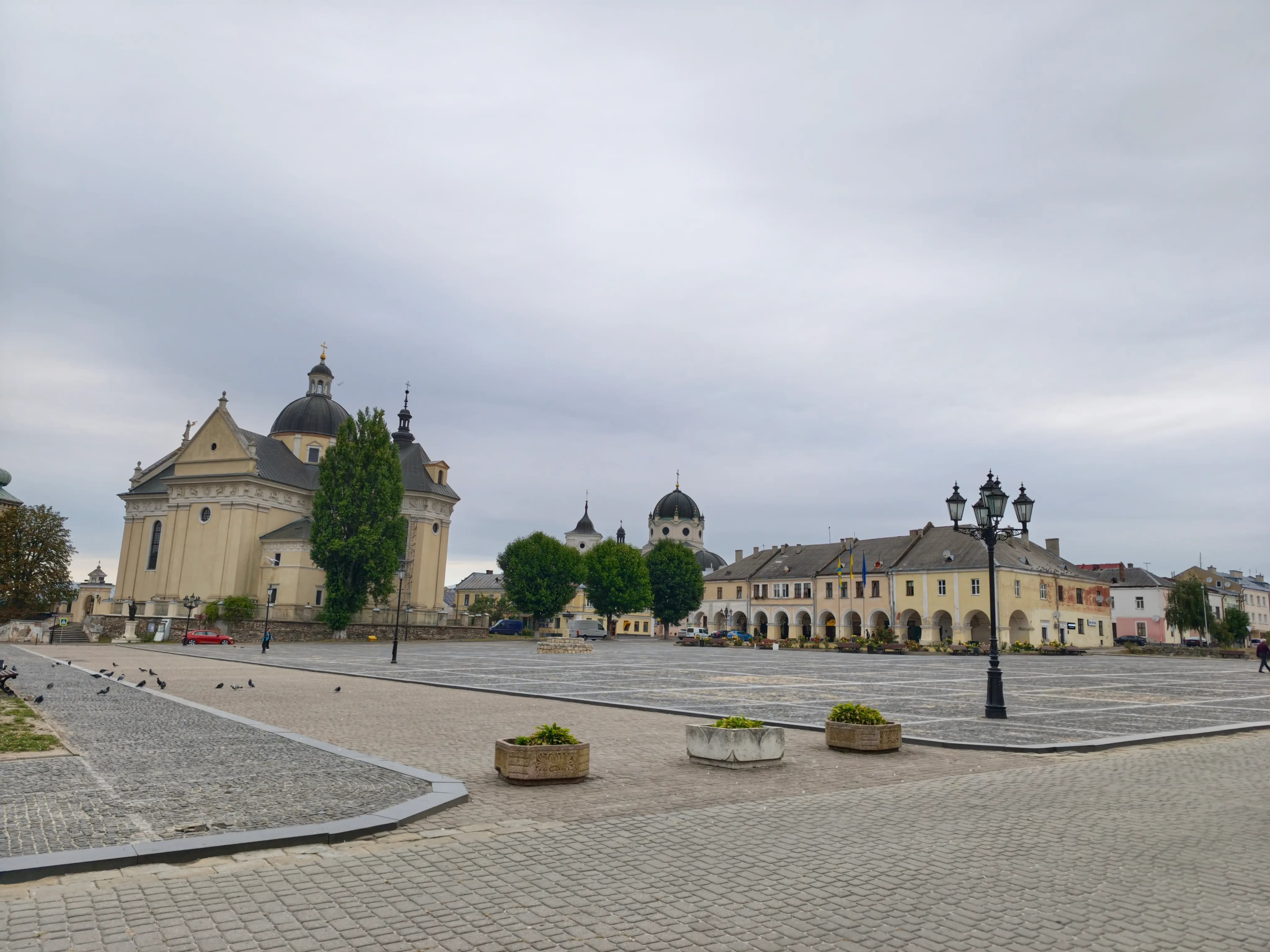
Most historic European cities grew organically—street by street, shaped by changing circumstances. Zhovkva, however, was designed on paper before the first stone was ever laid. Its central Vicheva Square is one of the largest Renaissance squares in Ukraine, still captivating visitors today with its faultless symmetry and clear structural concept. The "Ideal City" Concept: A City as a Human Body The town was founded by Hetman Stanislaw Zolkiewski in 1594, and the Magdeburg Rights granted in 1603 allowed large trade fairs to be held directly under the walls of the castle. The urban layout was designed based on the works of the Italian architect Pietro Cataneo and brought to life by the Lviv master builder Pavlo Shchaslyvyi (Paulus Italus). Its creators envisioned the "ideal city" as a single living organism, analogous to the human body: The Castle — the head; Vicheva Square — the lungs, providing breathing space for the urban community; The Old Town Hall (in the middle of the square) — the stomach; St. Lawrence Church and the Church of the Nativity of Christ — the two halves of the heart; The entrance gates — the limbs. An interesting detail: the dimensions of the square are practically equal to the area of the castle itself, which, according to Renaissance concepts, symbolized parity and harmony between authority (the lord) and the town community. Architectural Ensemble: What to Look For The square brings together Zhovkva’s key landmarks: Town Hall: Built in 1932 on the site of former casemates. An observation deck at the top of the tower offers the finest panorama of the city. Every hour, a hejnał—a town trumpet call—resounds from the tower, making it well worth lingering for a few extra minutes to hear. Zhovkva Castle: Encloses the southern side of the square. During the reign of King John III Sobieski, it served as a lavish royal residence. St. Lawrence Church: The burial vault of the Zolkiewski and Sobieski families. Known as the "Little Wawel" due to its rich decoration and the number of military commanders buried here. Pay attention to the bell tower: it has a noticeable tilt, which is why it is often called the Galician Tower of Pisa. Arcades (pidsinnia): The northern and eastern sides are lined with 17th–18th-century townhouses featuring open arcaded galleries. Trade once thrived beneath them in any weather—making it the best spot to soak up the atmosphere of the historic town. Hlynska (Hlynsk) and Zvirynetska (Zoo) Gates: Frame the square and connect the defensive walls with the castle and town hall. Hidden Details: What to Keep an Eye Out For The square reveals its secrets only to those who know where to look: Foundations in the center of the square: You can see the archaeological remains of the old town hall designed by architect Piotr Beber (1687), which was dismantled in 1822 due to its hazardous condition. The Pillory (pranger): Next to the ancient town hall stood a stone pillar used for the public punishment of criminals and debtors. During the 2003 restoration, archaeologists unearthed the foundational remains of both the town hall and the pillory, which are now exposed for public view. Area near Lvivska Street: This was once home to the market stalls of the Jewish Quarter, destroyed in 1941. Today, a green lawn and excavated outlines of ancient cellars serve as reminders of that past. Practical Information for Tourists A simple stroll across the square takes only a few minutes, but if you wish to dive deeper into its history, it is best to take a guided tour of the entire historic reserve. This will allow you to explore all of Zhovkva's monuments comprehensively in a single day. Photography and Atmosphere Vicheva Square is an open public space with free access. If you aim to capture quality architectural shots without the crowds, visit early in the morning. During the day and evening, the square comes alive with locals and visitors strolling through. Amenities Cozy cafes, restaurants, and shops are located nearby. For relaxation, there is a green park area equipped with benches, and free parking areas are available near the square.